
© Netflix
If you thought you’d seen all the evil the
world had to offer, think again. Netflix’s original Korean series “Karma”
(Korean title: 악연) has surged to global fame, ranking #2
on Netflix’s Global Top 10 Non-English Series list in its second week. It
has surpassed even “When Life Gives You Tangerines” – a hit drama that held a
strong presence for weeks. Despite its lower production budget, “Karma”
continues to climb the global charts, winning over viewers with its intense
storytelling and unforgettable characters.

© Netflix
Starring Park Hae-soo, Shin Min-a,
Lee Hee-jun, Kim Sung-kyun, Lee Kwang-soo, and Gong
Seung-yeon “Karma” weaves together six dark, morally complex stories
connected by a single word: karma. The drama explores whether it’s fate or poor
choices that tie people together in destructive ways – and if justice ever
truly prevails.
Adapted from a Kakao Webtoon of the
same name, this tightly-paced thriller is directed by Lee Il-hyung,
known for films “Remember” and “A Violent Prosecutor”. With a sharp, cinematic
style that blends black comedy, psychological drama, and neo-noir suspense,
Karma is not your average crime drama.

© Kakao Webtoon
The series has already amassed over 4.8
million viewing hours, ranking in the Top 10 in 35 countries, a true testament
to the global power of K-content. And it’s not just viewership numbers – “Karma”
is making waves on social media with fans praising its gritty realism,
unpredictable twists, and haunting performances.
Why It’s a Must-Watch:
The cast of Karma brings emotional
complexity and raw intensity to their roles. Park Hae-soo (of Squid Game fame)
transforms into “The Witness”, a seemingly average man whose dark desires
spiral into chaos. Shin Min-a gives one of her strongest performances yet as Yeon-ju,
a woman haunted by past trauma, whose tear-streaked face and shattered
expressions leave a lasting impression.

© Netflix
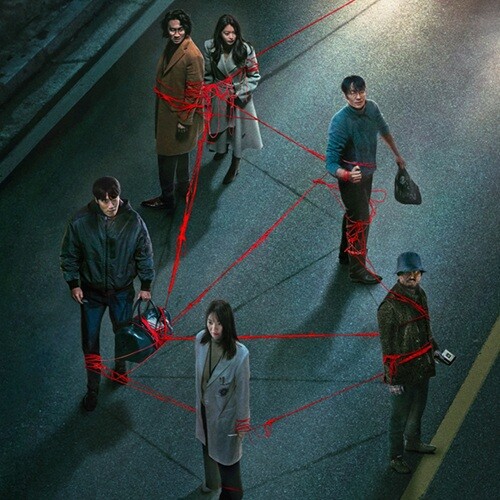
• Six Characters, One Fate
Each of the six main characters is drawn
into a violent, inescapable web of fate. From a ruthless loan shark to a
vengeful ex-con, from a hit-and-run driver to a mysterious burn victim, “Karma”
asks: who deserves redemption, and who is beyond saving?
© Netflix
• Puzzle-Like Structure
Told through interlocking episodes – like “The
Loan Shark,” “The Witness,” and “The Burned Man” – each chapter offers a piece
of the whole picture. As the story unfolds, connections become clearer, motives
get darker, and every character’s hidden truths surface. Viewers are kept
guessing till the final, gut-punching episode.

© Netflix
• Unexpected Twists
Don’t expect predictable storytelling. Just
when you think you've figured things out, “Karma” flips the narrative. A
character you once pitied may turn out to be the villain. A villain may reveal
heartbreaking depth. Plot twists are sharp, shocking, and refreshingly
unforced.

© Netflix
• Strong Supporting Cast
The drama also features powerful supporting
roles. Lee Kwang-soo adds layers of moral ambiguity as “The Eyeglass Guy”, torn
between guilt and denial. Gong Seung-yeon surprises as the enigmatic Yoo-jung,
whose late-series transformation adds a chilling edge. Special cameos by Kim
Nam-gil and Jo Jin-woong were also very exciting.

© Netflix
• Cinematic Visuals &
Direction
Director Lee Il-hyung combines gritty
realism with stylized visuals that enhance the psychological intensity. Bleak
cityscapes, sterile hospitals, and moody lighting create a claustrophobic
atmosphere where every scene feels like a ticking time bomb. The suspense never
lets up.

© Netflix
• Global Buzz
“Karma” is resonating across borders. Its
themes of guilt, consequence, and moral ambiguity are universal, but its
execution is distinctly Korean – raw, elegant, and uncompromising. With
placements in 35 global Top 10 lists and counting, it’s clear this thriller has
struck a nerve with international audiences.

© iMBC
While cathartic revenge may usually seem
like the ultimate goal, "Karma" leaves a heavier message: some bonds are too
toxic to untangle, and evil often wears an ordinary face. It’s a gripping
reflection on the human psyche that dares to ask—do the wicked ever truly pay?
 Free Shipping Over
 Ships From Korea


 전체 카테고리
 Trending Searches 🔥


 ARAB EMIRATES
 AUSTRALIA
 BELGIUM
 BRAZIL
 CANADA
 DENMARK
 FINLAND
 FRANCE
 GERMANY
 GREECE
 HONG KONG
 IRELAND
 ITALY
 JAPAN
 MACAO
 MALAYSIA
 MEXICO
 MONACO
 NETHERLANDS
 NEW ZEALAND
 NORWAY
 PHILIPPINES
 QATAR
 RUSSIAN
 SAUDI ARABIA
 SINGAPORE
 SWEDEN
 SWITZERLAND
 TAIWAN
 THAILAND
 UNITED KINGDOM
 VIET NAM


