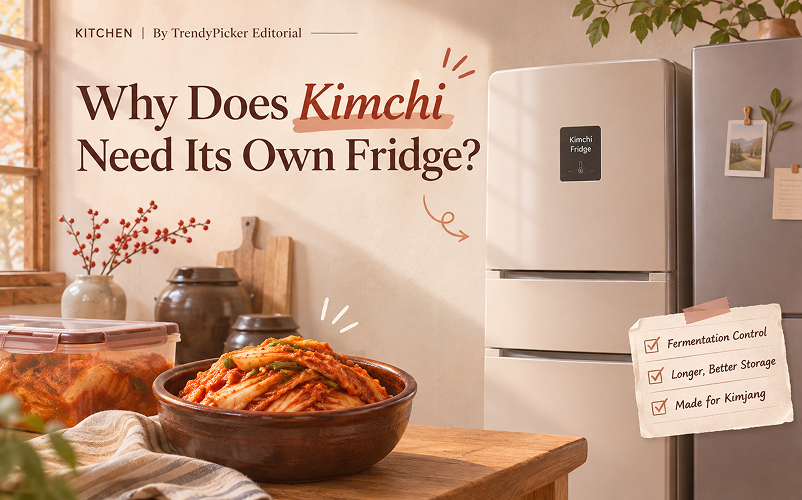
Open a kitchen in Korea and you may find a refrigerator beside another refrigerator—one labeled for kimchi. It raises a fair question: what can a kimchi fridge do that an ordinary fridge cannot?
Kimchi does not require a separate appliance. A regular refrigerator can keep it cold. The difference becomes useful when you make or store a large batch: kimchi continues to change in flavor, and a dedicated fridge gives you more control over how it ripens and how long it stays at the stage you like.
A Fridge Built Around Fermentation
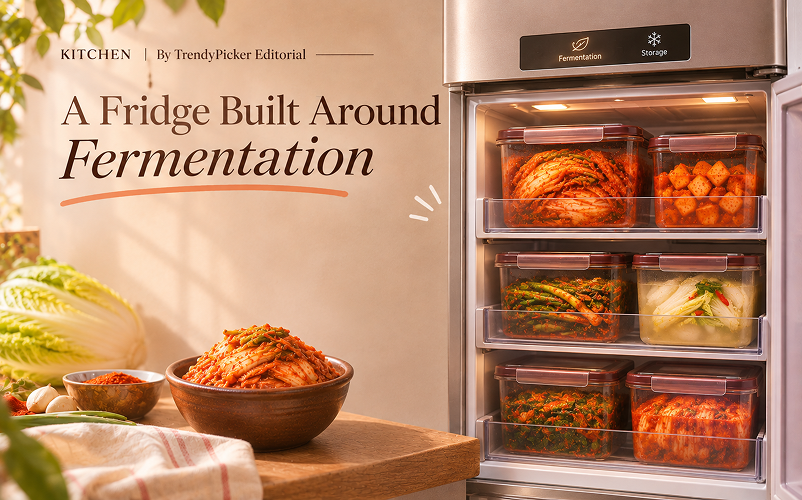
An ordinary refrigerator keeps a range of foods cold. The U.S. Food and Drug Administration recommends keeping it at 40°F (4°C) or below for food safety. You can store kimchi there, following the instructions on its package.
A kimchi refrigerator has a more specific job. On some models, you can choose a fermentation mode to ripen freshly made kimchi, then switch to a storage mode to slow further change. Some standing models let you set different compartments separately. LG’s guidance, for example, describes settings for different kinds of kimchi and different salt levels. These controls vary by model; “kimchi fridge” is not one universal temperature setting.
That distinction matters if you like kimchi at a particular point: fresh and crisp, more tangy, or deeply aged for cooking. The appliance gives a household a way to manage those stages instead of simply finding space wherever it can in the family fridge.
Why Is There So Much Kimchi to Store?

The second fridge makes more sense when you think beyond one jar. During kimjang, families and communities traditionally prepare and share large quantities of kimchi for winter. UNESCO recognizes kimjang as part of Korea’s intangible cultural heritage. A household storing several containers needs both room and a way to manage kimchi that will be eaten at different times.
Modern kimchi refrigerators answer that practical problem. Multiple compartments can be set for different storage needs, while a dedicated space leaves the everyday fridge available for everything else. It is a kitchen appliance shaped around a food that is made, shared, stored, and eaten over time.
What If You Only Have a Regular Fridge?

Start with a container that fits your fridge and the amount of kimchi you actually buy or make. Leave room for the contents as they mature, close the lid securely, and follow the kimchi maker’s storage directions. LG also advises keeping kimchi pressed down in its liquid and checking containers for overflow as it ripens.
TrendyPicker carries an ejen fermentation container with an inner lid for readers interested in Korean-style food storage. A container can help you organize kimchi in the fridge you already own; it does not give that fridge separate fermentation and temperature controls.
So why does kimchi have its own fridge? For some households, the answer is volume and control. For someone keeping a single jar, the regular fridge may be all the space they need. Either way, the extra appliance tells a bigger story: in Korea, storing kimchi is part of how people plan to enjoy it weeks and months after it was made.
 Free Shipping Over
 Ships From Korea


 전체 카테고리
 Trending Searches 🔥


 ARAB EMIRATES
 AUSTRALIA
 BELGIUM
 BRAZIL
 CANADA
 DENMARK
 FINLAND
 FRANCE
 GERMANY
 GREECE
 HONG KONG
 IRELAND
 ITALY
 JAPAN
 MACAO
 MALAYSIA
 MEXICO
 MONACO
 NETHERLANDS
 NEW ZEALAND
 NORWAY
 PHILIPPINES
 QATAR
 RUSSIAN
 SAUDI ARABIA
 SINGAPORE
 SWEDEN
 SWITZERLAND
 TAIWAN
 THAILAND
 UNITED KINGDOM
 VIET NAM


