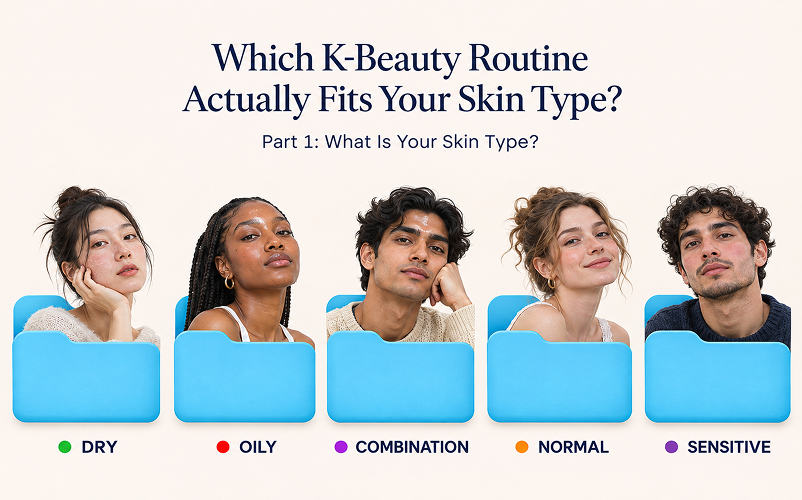
You find a K-beauty routine that promises a fresh, comfortable complexion. It works beautifully for the person demonstrating it. On your face, the cream feels heavy, or your cheeks still feel tight by lunchtime. Before adding another product, it helps to answer a simpler question: What is your skin type?
A K-beauty routine for your skin type begins with how your skin behaves, not with how many steps fit on your shelf. Use this guide to notice the difference between dry, oily, combination, and normal skin—and to spot sensitivity, which can come with any of them. In the next articles, we will build a practical routine for each type.
Start With a Clean Face

Wash your face gently and pat it dry. If you can, leave it free of skincare and makeup for about 30 minutes. Then look at your forehead, nose, chin, and cheeks separately. How do they feel? Where do you see shine?
You can press blotting paper lightly against those areas, but you do not need a special kit. Your skin’s appearance and feel are useful clues. Cleveland Clinic’s skin type guide suggests this simple check while noting that no single at-home test gives everyone a permanent answer.
Try it on an ordinary day. A hot afternoon, a very cold morning, or an unusually harsh cleanser can affect what you notice. You are looking for a pattern, not trying to pass a test.
Does Your Skin Feel Tight or Look Flaky?

If your face feels tight after washing and stays that way, or you regularly notice rough, flaky areas, it may lean dry. This can be especially noticeable on your cheeks.
Do not decide from one dry patch alone. Think about how your skin feels across several days and after your usual routine. In the dry-skin article, we will look at gentle cleansing and why a cream may feel more comfortable than a very light gel. The American Academy of Dermatology explains how moisturizer textures differ and why a richer one may suit dry skin.
Shiny Everywhere—or Just in the T-Zone?
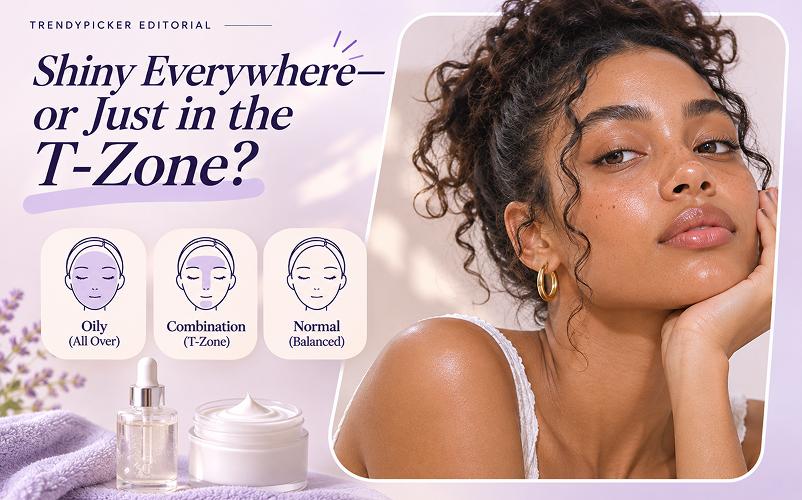
If your forehead, nose, cheeks, and chin tend to become shiny, your skin may lean oily. Oil is a normal part of skin; the question is how much you notice and where it appears. A face that feels slick soon after cleansing gives you a different clue from a nose that becomes shiny late in the day.
If the shine is mostly on your T-zone—the forehead, nose, and chin—while your cheeks feel normal or dry, you may have combination skin.
That distinction matters when choosing a routine. Your cheeks and nose do not always need the same amount or texture of moisturizer.
If your skin feels comfortable after washing and shows neither persistent tightness nor widespread shine, it may be normal. You can still have a skincare routine; you simply may not need to solve a strong oil-or-dryness problem.
Where Does Sensitive Skin Fit?

Sensitive skin is about how your skin reacts, rather than how much oil it produces. Products that seem ordinary to someone else may leave your face stinging, burning, or itchy. You can have sensitive skin that is also dry, oily, or combination skin, as Cleveland Clinic notes.
Notice whether discomfort appears after a particular cleanser or new product. If a reaction is persistent, painful, or difficult to explain, a dermatologist can help identify what is happening. “Sensitive” is a useful clue for choosing a gentler routine; it is not a diagnosis of the cause.
Your Starting Point for the Series
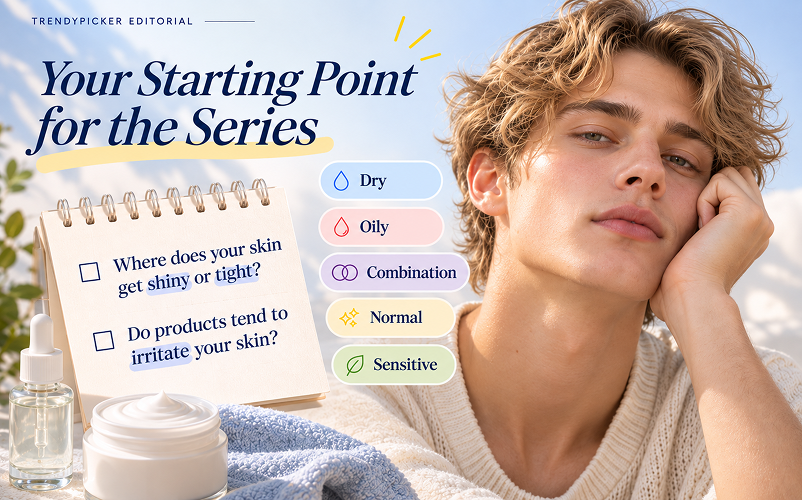
Write down two observations: where your skin gets shiny or tight, and whether products tend to irritate it. That gives you a more helpful starting point than copying a routine labeled “for everyone.”
Your skin can also change with the season and over time. The routine that feels right in a humid summer may need adjusting in a dry winter. For now, keep your answer simple: My skin leans dry, oily, combination, or normal—and it may also be sensitive. In the next part, we will turn that observation into a routine you can actually use.
 Free Shipping Over
 Ships From Korea


 전체 카테고리
 Trending Searches 🔥


 ARAB EMIRATES
 AUSTRALIA
 BELGIUM
 BRAZIL
 CANADA
 DENMARK
 FINLAND
 FRANCE
 GERMANY
 GREECE
 HONG KONG
 IRELAND
 ITALY
 JAPAN
 MACAO
 MALAYSIA
 MEXICO
 MONACO
 NETHERLANDS
 NEW ZEALAND
 NORWAY
 PHILIPPINES
 QATAR
 RUSSIAN
 SAUDI ARABIA
 SINGAPORE
 SWEDEN
 SWITZERLAND
 TAIWAN
 THAILAND
 UNITED KINGDOM
 VIET NAM


